“Are you there God? It’s me, Margaret”: Revisiting the classic coming-of-age story

I devoured Judy Blume books as a child. I can’t remember exactly how many of her books that I’ve read, but looking at the list, I’m guessing 14. From that number alone, I would consider her to be one of the most prolific authors of my adolescence. Blume’s books are known to tackle real subjects that tweens face, such as navigating friendships, puberty, bullying, body changes, and more. Several of her books have been mainstays on banned lists for decades, because she writes about (important) topics such as menstruation, masturbation, body image, birth control, and sex. 

I don’t remember the specifics of many of the books that I’ve read, but I do remember reading “Are you There God? It’s Me, Margaret.” When the movie adaptation was released in 2023, my mom and I saw it in theaters. I recently decided to revisit both. I think the book holds up as a beautiful coming-of-age story for adolescent girls, and the movie does a wonderful job of staying true to the book. I think either medium would be a great tool for any 10-14ish year-old, especially one that will be experiencing menstruation, buying a bra for the first time, and other experiences of puberty. I’m not going to use the rest of this post as a review or a summary, but more so as a reflection of some of the aspects of the overall story and how the movie portrayed the plot point.  

The Puberty of it all: One of the major themes throughout the book, and one of the main reasons why I think it’s such an important read for young people, is Margaret’s journey into puberty. Buying a bra, praying and chanting for chest growth (who could forget “We must, we must, we must increase our bust!”), waiting for the first menstrual cycle, buying deodorant… I had forgotten just how BIG all of these moments felt, but this book and movie transport me right back. Blume and the filmmakers are able to portray these moments in a sensitive and honest way. Puberty is confusing, scary, and stigmatized (see: book bans) and I believe this story can help tweens feel seen and less alone.

Religion: The other major plot line running through the book is Margaret’s grappling with religiosity. With a Jewish dad and a Christian mom who was disowned by her parents due to marrying someone Jewish, Margaret’s parents have decided to raise Margaret without a religious tradition. Throughout the book, Margaret prays to God (she thinks, maybe), sometimes hilariously, like when praying for her chest to grow, and often tenderly. She spends the book exploring faiths, looking for God in different church services, but only ever feeling God when she is alone. Something I love about this storyline is that it doesn’t end wrapped in a bow. At the end of the book, Margaret remains confused about religion. She even abandons talking to God at one point, finding her way back by the end.

Changing bodies: There’s a character in the story named Laura Danker who has developed at a younger age than the rest of the girls in Margaret’s class, and is taller than all of the boys. Rumors circulate around Laura that she is much more sexually experienced than the rest of the girls, and she is bullied and picked on by her classmates. I did not remember this storyline and was pleased by its inclusion and nuance. Sexualization of girls and women is a huge problem in our society, and many women can remember the first time they were sexually harassed, often in their young teens. I think Blume was able to touch on this subject in an age-appropriate manner, while also reminding girls that it can be hard to be the one that goes through puberty first. 

Other things about the movie specifically that I loved: I enjoyed both my reread and rewatch of the movie, but the movie especially feels like a warm hug. It brought the book to life so beautifully, and felt both timeless and nostalgic. Here are some random things that I appreciated about the movie:

  • The actors: Rachel McAdams and Kathy Bates are just amazing, and Abby Ryder Fortson, who played Margaret, gave such an earnest performance
  • The early 1970s soundtrack and fashion
  • The expanded storyline of Barbara, Margaret’s mom. In the movie, Barbara is trying to reinvent herself, quitting her job and trying to fit the mold of a suburban mom. She joins every committee in the PTA and is miserable. At the end of the movie she’s back to teaching art classes and quits the PTA. 
  • The blink-and-you-miss-it cameo by Queen Judy herself

This reread and rewatch were a delight for me, and I think stories like Margaret are immensely important for young people to have at their disposal. 
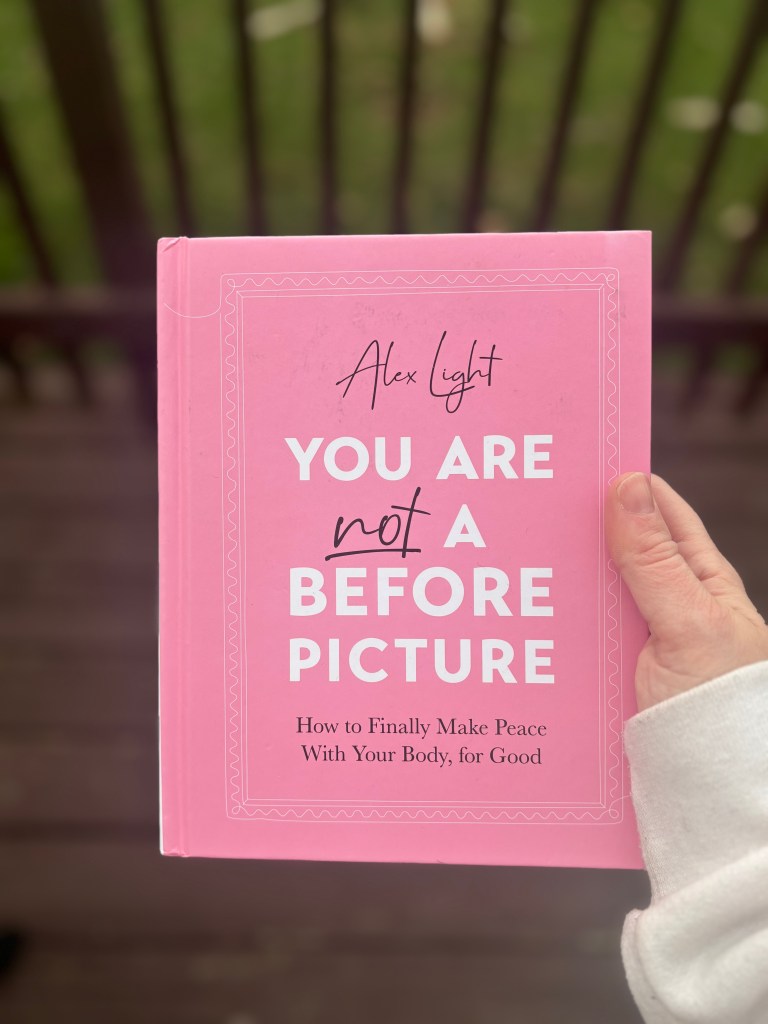
“You are Not a Before Picture” by Alex Light

2025 is not going to be known for being a body positive, or even a body neutral year. In many ways, it feels like our body ideals and cultural attitudes around food, bodies, and exercise are time traveling back toward the early 2000s. Diet culture is alive and thriving, and we need tools at our disposal to help combat all of the harmful messaging that diet culture engrains in us. Enter Alex Light’s You are Not a Before Picture: How to Finally Make Peace With Your Body, for Good. 

Light describes this book as a “body image bible,” and I tend to agree, as it is an expertly researched encyclopedia of all things body image: a history of diets, what happens to our bodies when we diet (spoiler: diets don’t work), beauty trends, the impact of the media, fitness, weight gain, and more. It really is a comprehensive guide to all things body image-related. As someone who is well-versed in body image, but hasn’t been able to immerse myself in the literature as much as I would like in the last few years, it was a great re-introduction to the genre. For someone struggling with body image, or just starting to learn about diet culture, this serves as a great primer. 

I found each chapter of this book to be well-researched, and I think that I will be returning to it over and over again, for both personal and professional purposes. My copy is already well-highlighted. One of my favorite chapters was about the history of diets, from the first-known diet book in the 1500s, to the weight-loss apps of the mid-2010s (this book was first published in 2022, so right before the Ozempic boom). Through learning about the ever-changing diet advice and beauty standards, it is clear that diets have always been a way to uphold the patriarchy.

Something I really appreciated about this book is Light’s acknowledgment of her identity and privilege and a straight-sized, cis white woman. Throughout the book, she interviews women in marginalized bodies to help us all gain a better understanding of the systems of oppression that help to maintain diet culture. She shares how misogyny, racism, homophobia and transphobia, and capitalism all contribute to the dangerous beauty standard that we all are pressured to adhere to. Light explains that body positivity has its roots in the radical political movement of fat acceptance, which was created for and by women of color. As described in the book, the body positivity movement has transformed into a place “dominated by privileged bodies” and commodified by content creators and brands. To that point, I often find this reality is often missing from the discourse by body image experts with Light’s (and my) privileges, so I was pleased with that portion of the book.

I could write an essay on each of the chapters of this book, and as stated previously, I will go back time and time again as I do delve deeper into specific topics. Throughout the book, Light also weaves her own experiences with an eating disorder and body image struggles, and I am grateful for her vulnerability. She is also a great follow on instagram (@alexlight_ldn). This book belongs in every body image collection.

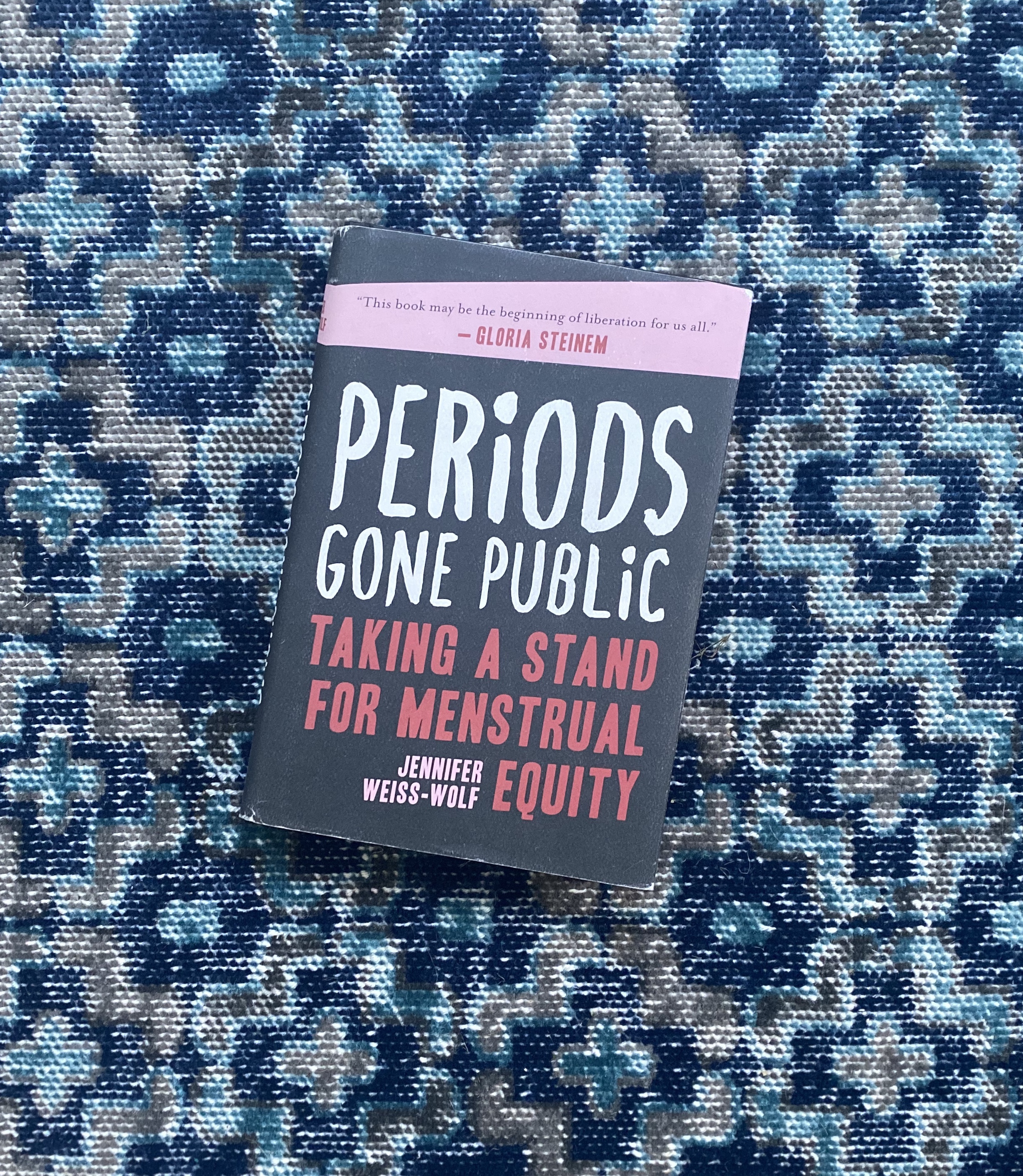
“Periods Gone Public: Taking a Stand for Menstrual Equity”

Note: I wrote this toward the end of 2019, but have not posted it before:

I am pretty pumped fired up about the topic of menstrual equity. I have been collecting pads, tampons, and other period products since the beginning of November, and have gotten awesome response from friends and family. I love you all! The book that I chose to read is called “Periods Gone Public: Taking a Stand for Menstrual Equity,” by lawyer and menstrual activist Jennifer Weiss-Wolf. This book includes a pretty comprehensive examination of period poverty, or lack of adequate access to menstrual products. While reading the book I felt simultaneously enraged and hopeful, which is how I often feel reading about issues of inequality and potential solutions.

Menstruation is a great example of a topic that is so enmeshed in stigma that it seems revolutionary to even talk about. As Weiss-Wolf puts it on page 11, periods have been stigmatized for as long as patriarchy has been around. You cannot separate period stigma from patriarchy, and you cannot separate stigma from access to care. In the beginning chapters, Weiss-Wolf shares the history and epistemology of menstrual-related words and products. She shares damning passages from religious texts and contends that claims of weakness/impurity are exactly how menstruation has been leveraged as a means to exclude women from full civic participation- in the church as well as in society at large (pg. 7). Just think of the ridiculous claims people make as to why women would be too emotional in an high stakes role (meanwhile, our current so-called president is throwing tantrums on the daily but OKKKKKK).

Honestly I could write a long research paper about the topics in this book but I want you to read it for yourself and share it with all of your friends. I tend to get carried away writing so I will try to keep it short…or at least not too long. Weiss-Wolf takes us on a global journey, where rates of access to products are abysmal in some places. Let’s look at this quote from pg. 29:
“Around the globe on any given day, more than 8 hundred million people are menstruating. At least 5 hundred million lack adequate resources for managing their periods.”
This leads to people with periods missing out of education, being exiled from society, prone to disease or infection, and sometimes being forced to have transactional sex for products. This is a topic in itself, but Weiss-Wolf highlights some very cool innovations to try to curb these products. It’s important that there are localized solutions, because every community has its own unique cultural practices and barriers. One great example of this is in Coimbatore India, where a local husband and entrepreneur invented a simple machine to produce inexpensive and disposable pads. This has allowed many people access to menstrual products, as well as creating jobs in the area. Weiss-Wolf includes a couple other really cool innovations in different parts of the world, localized to fill a specific need for a universal problem.

Being a lawyer and policy maker, Weiss-Wolf creates a good balance between innovation/giving and creating systemic change by advocating for policy changes. In our country, almost every state has a tax on tampons, because they are not considered to be necessities in most tax codes. After reading the book, three areas on the national level that are in need of the most change are the following: access to products for the homeless, access to products for those in prison, and access for people who are transgender or gender nonconforming. Again, Weiss-Wolf shares ways to get products to people in need, as well as policy changes we can advocate for which guarantees access to all. The capital-T Truth is that no effort that individuals make will ever be enough- we have to change the system. But that doesn’t mean we shouldn’t do all we can to give what we can to those in need.

Because of my background in women’s studies and women’s health, I feel I am a little more aware of issues of menstrual equity than the average citizen. But WOW there were so many eye-opening passages in this book. There are accounts and data about the experience of menstruating while homeless and while in prison. While I’ve thought about these issues before, I had never actually thought about the specifics. Like- what if you don’t have a tampon or pad? What if you don’t have access to privacy of any kind? The number of pads that people in prison receive on a monthly basis is abysmal. The most marginalized in our communities are not having their basic needs met, and this has dire consequences. Wow I could say SO much more about this. About just the stigma, the lack of public education related to menstruation and how that bleeds (get it?) into all policies related to women’s bodies (and people with vaginas). I could write a whole book looking specifically at homeless people with periods, or periods in prison, or having a period while trans in a country with LAWS ON THE BOOKS specifying archaic bathroom guidelines. I could write about menstrual access and education on a global level. But I am going to stop here for now and I sincerely hope that you check out this book for all the important information in it. I will be back to talk more about this soon, share about my donation drive (and hopefully inspire you to do one in your community!), and to give you information about policies that we can help to change.

Reading “Americanah”

by Chimamanda Ngozi Adichie

Hi reader/friend! I don’t think this changes the perspective I had at all, but full transparency: I wrote this blog post at the beginning of December. I have a few drafts that I haven’t published yet, and this is one of them! More of those will be published soon, as well as new/current posts! Enjoy 🙂

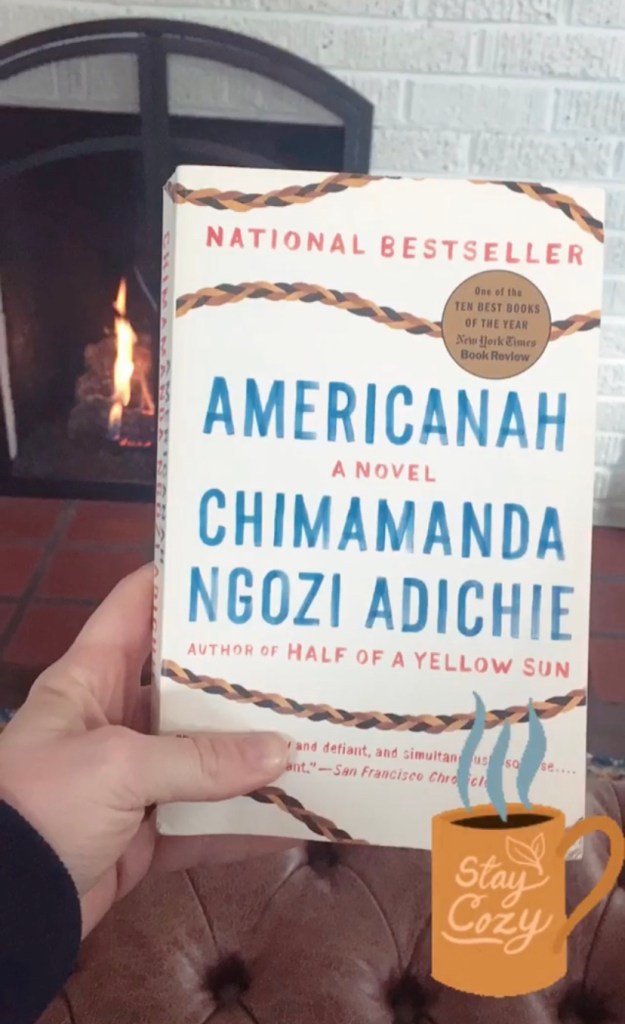
Evidence I read this in the winter…

I just finished reading the novel “Americanah” by Chimamanda Ngozi Adichie and wow is it a masterpiece. I had an idea it was going to be impactful given all of the accolades the book has received since it was published in 2013. I knew of Adichie from her brilliant TED talk about feminism. Adichie manages to weave together a love story with brilliant commentary on blackness. As a New York reviewer put it, “Adichie is to blackness what Philip Roth was to Jewishness: its most obsessive taxonomist, it’s staunchest defender, and its greatest critic.”

As with all of my blog posts about books, this isn’t a review, and I’m not going to give anything away, because I want to encourage YOU to read the book. But I do want to give a brief synopsis. Americanah follows two main protagonists, Ifemelu and Obinze, and spans a couple decades of their lives. They went to school together in Nigeria and assumed a romantic relationship in high school. Obinze dreams of going to America, but in a sick twist of fate it is Ifemelu who is able to get a visa and move to America, while Obinze stayed and later lived undocumented in London. Readers learn of the reality of living in America and the U.K.  as an immigrant, especially as a non-American black person. Ifemelu starts a blog and shares her experiences connected to race. Adichie cleverly includes a lot of commentary on race, as Ifemelu’s blog posts are interwoven into the story line.

I dog-earred so many pages with quotes from the book that I found impactful or important. I won’t share all of them considering it’s a 600 page novel, but I am going to share quite a few. I can’t think of a better way to learn about someone else’s life experience than by reading their own words, listening, and immersing yourself in their story:

“She said…that it was absurd how women’s magazines forced images of small-boned, small-breasted white woman on the rest of the multi-boned, multi-ethnic world of women to emulate” – pg. 219

“…all understood the fleeing from war, from the kind of poverty that crushed human souls, but they would not understand the need to escape from the oppressive lethargy of choicelessness.”- pg. 341

“I came from a country where race was not an issue; I did not think of myself as black and I only became black when I came to America.”- pg. 359

“Racism should never have happened and so you don’t get a cookie for reducing it.”- pg. 378

“In America, racism exists but racists are gone.” (DRIPPING with sarcasm of course)- pg. 390

“Blacks actually don’t WANT it to be about race. So when they say something is about race, it’s maybe because it actually is?”- pg. 404 

“…of course we’re all prejudiced, but racism is about the power of the group and in America it’s white folks who have that power.”- pg. 405

“It is the final infantilization and informalization of America! It portends the end of the American empire, and they are killing themselves from within!”- pg. 489

I hope you go read this book!! If you’ve read it, what were your thoughts? Let me know!

(Don’t) Call me Crazy

Monthly Project- October 2019

The book I chose to read for my mental health theme this month was (Don’t) Call me Crazy: 33 Voices Start the Conversation about Mental Health, edited by Kelly Jenson. What initially drew me to the book was the variety of authors and the diversity of their experiences, woven with a common thread. I was also interested because it is marketed as a young adult book, and I am always on the quest for accessible and relatable material about important topics that affect our young people. (Don’t) Call me Crazy features excerpts from well-known celebrities such as Kristen Bell and Nancy Kerrigan, as well as from lesser-known artists and writers.

I believe listening to someone’s personal narrative is one of the most powerful catalysts for empathy, especially in terms of mental health. With such a broad and misunderstood topic, listening to someone’s personal experience with mental illness helps us to understand the enormity of this disease. This book does that well. The essays are personal, vulnerable, and sometimes hard to read. But please read them. They are about people’s lives and they are important.

Jensen compiled essays from accomplished figures who come from a variety of backgrounds and have been affected by mental illness in different capacities. One powerful essay was written by a former Marine suffering from PTSD, a story of vulnerability and strength that we need to hear more often. An actor shared his battle with body dysmorphia, and the pain from ensuing plastic surgeries that he became addicted to. There are essays about struggles (and triumphs!) with bipolar disorder, eating disorders, depression, anxiety, OCD, and more.

I really appreciate that Jensen included stories from people with diverse backgrounds and upbringings. Our identity and how we feel we belong in the world will impact how our mental illness is perceived and the type of care we will receive (if we receive treatment at all). I read this book a few weeks ago now and while I think all of the essays are equally as powerful, one has stuck with me the most. Meredith Russo bravely writes about her time in a psychiatric ward to treat severe depression and hypomania. Russo is trans and nurses and doctors kept using the wrong pronouns and calling her by her dead name (name given at birth). They refused to give her a razor to shave her face, and as the days went by she suffered more, frequently experiencing suicidal ideation. Finally an administrator at the hospital steps in and ensures Russo is properly cared for. Slowly, with the right care and therapy, Russo is strong enough to go home. What hit me the hardest was that in a time of crisis, Russo’s caretakers were not respecting her humanity and causing her a great deal of pain. My heart wrenched for her reading that essay.

The essays in this book are honest, sometimes upsetting, but they are real, and they are also full of hope. The common theme is clear- everyone feels better once they seek treatment. Everyone feels better when they are treated with dignity and respect, and able to live their lives in the way that suits them best. One essay states that there IS no normal. No one brain or perspective or experience is the same. Our sensitivities and challenges are part of what makes us US. I’ll leave you with one of my favorite quotes from the book by actress Lisa Jakub. I like it so much because I SO relate to it, and it’s a good reminder for me and for us all:

“It took me a long time, but I finally understood that all the things I felt I needed to hide were actually my superpowers. My sensitivity was something to be proud of. The fact that I feel things so deeply means I’m compassionate. I care. I’m engaged and alive and invested in the world…When I learned to accept the things that I was ashamed of and worked with them instead of constantly fighting against them- I could do anything. – pg. 155

Friend, I encourage you to read these essays. Beyond that, I encourage you to listen. Listen to your friends and strangers experiences with mental illness. Listen to the way mental illness is talked about (or ignored) on TV, in the lunchroom, on Capitol Hill. Together we can make the world a more understanding and empathetic place.

Thoughts on Lindy West’s “Shrill”

Spoiler Alert- I loved it

I received “Shrill” for Christmas 2016, the year this memoir was published. I knew I would love it, but so little time and so many books, right? I just read it a week ago, and I OBVIOUSLY did love it. I have been a fan of Lindy West’s for several years, since she was writing at “Jezebel.” (To be honest, I stopped reading it regularly after she and a couple other writers left.) West is my favorite kind of feminist writer, reminding me of the likes of Roxane Gay and Jessica Valenti. She is able to write about serious topics of inequality with humor, a take no shit attitude, and yet conveys warmth and tenderness.

As a fat feminist who writes openly about abortion, fatphobia, rape jokes, and other WILDLY POPULAR topics, West has had no shortage of online trolls. In “Shrill,” West writes about all of the above topics, as well as her experiences with trolls. If you didn’t think misogyny ran rampant in online comments before (I envy you?), you definitely will think again after reading this book. So I’m not going to do a classic book review or analysis here. My analysis is: it’s good, you’ll learn, you’ll laugh a lot and possibly cry a little, please read it. Instead, I am going to share a few of my favorite passages, and expand on those a little.

On fatness and fatphobia:

“I wasn’t unnatural after all; the cultural attitude that taught me so was the real abomination. My body, I realized, was an opportunity. It was political. It moved the world just by existing. What a gift.”- pg. 79

“You can’t fix a problem by targeting its victims…The only answer is to decide we’re worth helping.”- pg. 148

I definitely found myself questioning some of my own internalized biases against fat bodies while reading West’s experiences with fatphobia. As someone who has always had thin privilege, I can’t begin to know what it’s like to be constantly stigmatized and judged so openly. I am really passionate about body positivity- I wrote my master’s thesis about eating disorders and I facilitate body image presentations to youth. But we are all complicit in the oppressive system that perpetuates these cultural biases. That’s why it’s so important to critically examine them and where they came from. In particular I find myself having to consciously unpack the myth that health = morality, and that we can tell a person’s health by what they look like. Even though I KNOW the data that disputes this idea, it is such a pervasive and damning idea in our society. Story telling is so important because it helps us to get out of our own bias and perspective and learn someone else’s. Often your own worldview will shift and expand.

On rape jokes and why they aren’t funny (because it apparently isn’t obvious?)

Let me preface this by giving you all a little background. A few summers ago, comedian Daniel Tosh told a rape joke in the middle of a comedy set, a woman in the audience yelled out that rape jokes aren’t funny, and Tosh retorted that “wouldn’t it be funny if like 5 guys just raped her right now?” (BECAUSE GANG RAPE HAHAHA) Needless to say, the woman walked out of the show, mortified. West wrote a couple pieces about the incident for Jezebel, received national attention, and went on to discuss it on a couple TV news shows. Male comics from both sides of the issue rushed to add their own commentary. West received an inconceivable amount of online vitriol from almost exclusively men, who sexualized her and threatened sexual violence. In the end, it was ironically this online bullying that opened up some people’s minds. The evidence that rape jokes clearly correlated with sexualized misogynistic harassment was right there. So here are a couple passages from my favorite chapters of “Shrill”:

“Comedy doesn’t just reflect the world, it shapes it… So why would we pretend, out of sheer convenience, that stand-up exists in a vacuum?…Art isn’t indiscriminate shit-flinging. It’s pure communication, crafted with intention and care…So shouldn’t we be welcome to examine that purpose, contextualize it within our culture at large, and critique what we find?”- pg. 165-166

“…what we say affects the world we live in, that words are both a reflection of and a catalyst for the way our society operates… When you talk about rape, you get to decide where you aim: Are you making fun of rapists? Or their victims? Are you making the world better? Or worse? It’s not about censorship, it’s not about obligation, it’s not about forcibly limiting anyone’s speech- it’s about choice. Who are you? Choose.”- pg. 171

MIC DROP. In those passages, West eloquently articulates some of the reasons why I am so interested in the media, as it is both a “reflection of and a catalyst for” our beliefs and realities. Analyzing media is so important because if not critiqued, we take it as fact, as the natural way of the world. One point that West makes can be broadened to the issue of free speech in general. Lately I feel like people are invoking the First Amendment as a sort of blanket permission slip to say anything they want, anytime they want. Uhhh no one is saying that people should go to jail for making rape jokes (I mean people who actually commit rape don’t usually even go to jail so…). What West is saying is that you have a CHOICE in what you convey to others. In a society where 1 in 5 women are raped, often blamed for their assault, and perpetrators rarely see prison, are you sure making a joke out of traumatic sexual violence is the choice that you want to make? Say what you want but know there will be consequences if you are belittling someone’s humanity. We will hold you accountable if you threaten the marginalized and incite violence with your words (COUGH RICHARD SPENCER COUGH).

Let’s say a comedian is making light of rape on stage and you’re a survivor in the audience (statistically there will be several). You feel more stigmatized after hearing this, possibly re-triggered or even experiencing PTSD. Furthermore, you see the rest of the audience laughing, and you probably feel some shame. And you wonder why people don’t come forward when they are victims of assault? In this culture? Rape jokes aren’t funny; they contribute to rape culture and victim blaming. You have a choice- who are you going to be?

Just a line that made me laugh so much I almost peed:

“Oh, you think you’re a badass for leaving the book jacket on ‘Half-Blood Prince?’ You think it makes you a ‘total nerd’ because you’re trying to get through ‘A Clash of Kings’ before the next season of ‘Game of Thrones’ comes out? Try reading Robert Jordan on the bus in 1997 with your bass clarinet case wedged between your legs while wearing a Microsoft Bob promotional T-shirt your dad brought home from work. Then try losing your virginity.”- pg. 42

LOL. OH and the Hulu show “Shrill” starring Aidy Bryant is loosely based off of this book/West’s life and she is really involved in the show. I haven’t watched it yet but will let you all know when I do! In the meantime, get your hands on this book, read it, and live laugh love learn.