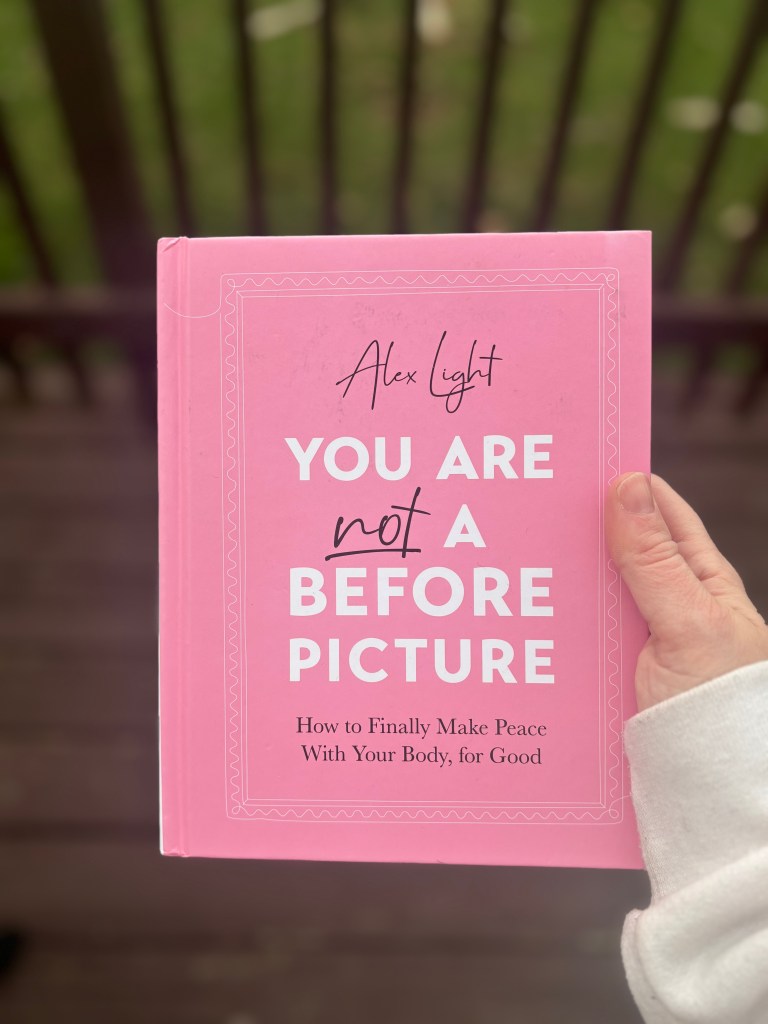
“You are Not a Before Picture” by Alex Light

2025 is not going to be known for being a body positive, or even a body neutral year. In many ways, it feels like our body ideals and cultural attitudes around food, bodies, and exercise are time traveling back toward the early 2000s. Diet culture is alive and thriving, and we need tools at our disposal to help combat all of the harmful messaging that diet culture engrains in us. Enter Alex Light’s You are Not a Before Picture: How to Finally Make Peace With Your Body, for Good. 

Light describes this book as a “body image bible,” and I tend to agree, as it is an expertly researched encyclopedia of all things body image: a history of diets, what happens to our bodies when we diet (spoiler: diets don’t work), beauty trends, the impact of the media, fitness, weight gain, and more. It really is a comprehensive guide to all things body image-related. As someone who is well-versed in body image, but hasn’t been able to immerse myself in the literature as much as I would like in the last few years, it was a great re-introduction to the genre. For someone struggling with body image, or just starting to learn about diet culture, this serves as a great primer. 

I found each chapter of this book to be well-researched, and I think that I will be returning to it over and over again, for both personal and professional purposes. My copy is already well-highlighted. One of my favorite chapters was about the history of diets, from the first-known diet book in the 1500s, to the weight-loss apps of the mid-2010s (this book was first published in 2022, so right before the Ozempic boom). Through learning about the ever-changing diet advice and beauty standards, it is clear that diets have always been a way to uphold the patriarchy.

Something I really appreciated about this book is Light’s acknowledgment of her identity and privilege and a straight-sized, cis white woman. Throughout the book, she interviews women in marginalized bodies to help us all gain a better understanding of the systems of oppression that help to maintain diet culture. She shares how misogyny, racism, homophobia and transphobia, and capitalism all contribute to the dangerous beauty standard that we all are pressured to adhere to. Light explains that body positivity has its roots in the radical political movement of fat acceptance, which was created for and by women of color. As described in the book, the body positivity movement has transformed into a place “dominated by privileged bodies” and commodified by content creators and brands. To that point, I often find this reality is often missing from the discourse by body image experts with Light’s (and my) privileges, so I was pleased with that portion of the book.

I could write an essay on each of the chapters of this book, and as stated previously, I will go back time and time again as I do delve deeper into specific topics. Throughout the book, Light also weaves her own experiences with an eating disorder and body image struggles, and I am grateful for her vulnerability. She is also a great follow on instagram (@alexlight_ldn). This book belongs in every body image collection.

Talking to Teens about Body Image and the Media

My greatest passion- that *thing* that lights my soul on fire, is body image education. This weekend I was able to add kindling to that fire with two experiences. On Friday I was privileged enough to be a guest on my friend Tiffany Baker’s IGTV show- check out our Instagram Live here. We had a great conversation around self-compassion, finding balance in health, and raising kids in a world where the media still so often portrays one beauty narrative. During our conversation, I discussed a few activities that I do when I work with youth on these topics. This morning I facilitated a body image and media literacy workshop to the 8th grade Confirmation class at my local church. Facilitating these workshops is something that truly brings me joy, and I’ve been privileged enough to lead them for both youth and parents. I cover a lot of material during these presentations, and I am not going to go through everything I do, but I wanted to share an overview of what I do, and a couple of takeaways or skills that I hope to share during these workshops:

Body Image and Eating Disorders

Focus/takeaway: Definitions and statistics; how societal factors can influence health

I usually start by presenting to the youth facts and definitions about body image and eating disorders. I share some statistics about the prevalence of eating disorders, especially among teens, and the mortality rates. I briefly touch on specific eating disorders, and then we define what body image is and what outside factors could impact the way someone sees themselves.

Idealized Body Types and Media Literacy

Focus/takeaway: the ability to critically analyze media !

I lead the youth through a brainstorm activity in which we discuss the “ideal” body type portrayed in the media for both men and women. We talk about and I provide visual examples of whitewashing (in which Black people and people of color are photoshopped to have lighter skin), photoshop, and filters. I then introduce my favorite part of the workshop which is an ad analysis activity. The kids break off into groups and are given an ad and a set of questions to discuss. They’re usually the most talkative during and following this activity. We talk about the importance of being able to critically analyze media. I hope that I am providing them with the tools to understand that images in the media aren’t necessarily real, they aren’t healthy to attain, and the beginning understandings of the race and gender politics of it all.

Objectification and Representation

Focus/takeaway: recognizing objectification in the media and the importance of representation

I like to share examples of objectification of bodies in the media and introduce the concept of self-objectification. Depending on the age of the group, I might explain how objectification is related to violence against women. I usually share a trailer or clip from the film “Misrepresentation” and we discuss the importance of representation and diversity in front of and behind the camera- size, ability, gender, race, diversity.

As I said, this is such a broad topic that I could do a workshop on so many individual aspects of it all. My hope is that if youth get one thing out of it, it is that they can critically analyze the media and understand that there is no need to change anything about the way that they look, or who they are.