“You are Not a Before Picture” by Alex Light

2025 is not going to be known for being a body positive, or even a body neutral year. In many ways, it feels like our body ideals and cultural attitudes around food, bodies, and exercise are time traveling back toward the early 2000s. Diet culture is alive and thriving, and we need tools at our disposal to help combat all of the harmful messaging that diet culture engrains in us. Enter Alex Light’s You are Not a Before Picture: How to Finally Make Peace With Your Body, for Good. 
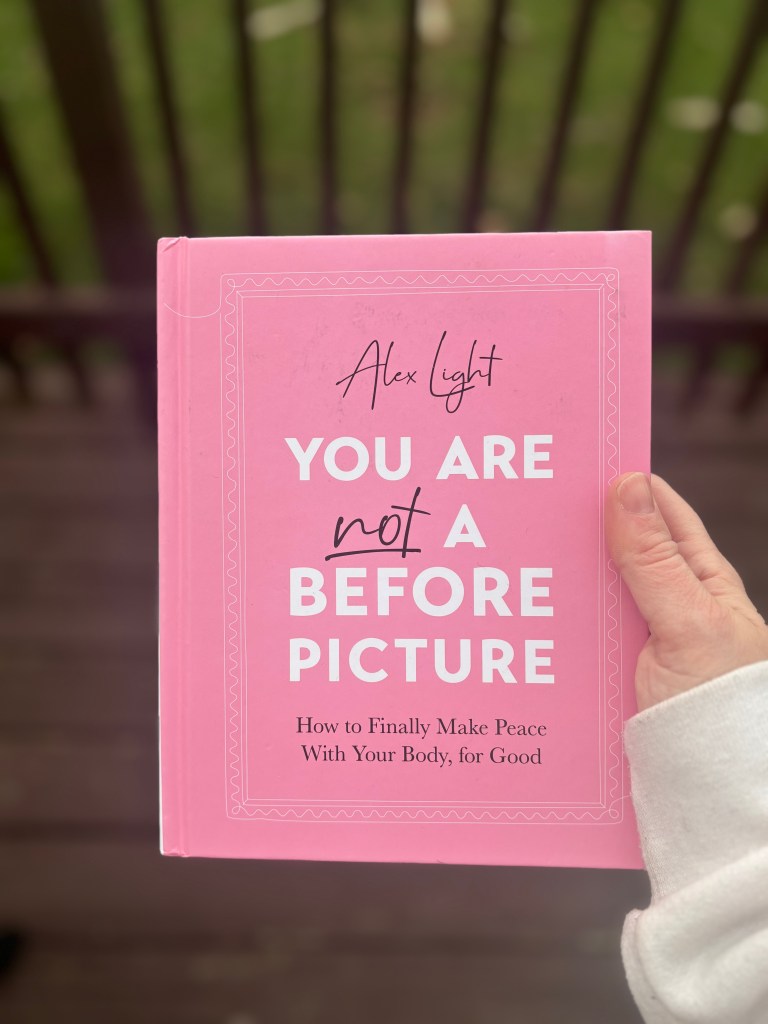
Light describes this book as a “body image bible,” and I tend to agree, as it is an expertly researched encyclopedia of all things body image: a history of diets, what happens to our bodies when we diet (spoiler: diets don’t work), beauty trends, the impact of the media, fitness, weight gain, and more. It really is a comprehensive guide to all things body image-related. As someone who is well-versed in body image, but hasn’t been able to immerse myself in the literature as much as I would like in the last few years, it was a great re-introduction to the genre. For someone struggling with body image, or just starting to learn about diet culture, this serves as a great primer. 

I found each chapter of this book to be well-researched, and I think that I will be returning to it over and over again, for both personal and professional purposes. My copy is already well-highlighted. One of my favorite chapters was about the history of diets, from the first-known diet book in the 1500s, to the weight-loss apps of the mid-2010s (this book was first published in 2022, so right before the Ozempic boom). Through learning about the ever-changing diet advice and beauty standards, it is clear that diets have always been a way to uphold the patriarchy.

Something I really appreciated about this book is Light’s acknowledgment of her identity and privilege and a straight-sized, cis white woman. Throughout the book, she interviews women in marginalized bodies to help us all gain a better understanding of the systems of oppression that help to maintain diet culture. She shares how misogyny, racism, homophobia and transphobia, and capitalism all contribute to the dangerous beauty standard that we all are pressured to adhere to. Light explains that body positivity has its roots in the radical political movement of fat acceptance, which was created for and by women of color. As described in the book, the body positivity movement has transformed into a place “dominated by privileged bodies” and commodified by content creators and brands. To that point, I often find this reality is often missing from the discourse by body image experts with Light’s (and my) privileges, so I was pleased with that portion of the book.

I could write an essay on each of the chapters of this book, and as stated previously, I will go back time and time again as I do delve deeper into specific topics. Throughout the book, Light also weaves her own experiences with an eating disorder and body image struggles, and I am grateful for her vulnerability. She is also a great follow on instagram (@alexlight_ldn). This book belongs in every body image collection.

Anxiety

9/6/20

Sometimes when i’m feeling joy

I get sad

A knot rises in my stomach and darkens the sun

I know what it is

A familiar foe

You probably know it too

Anxiety

Sometimes active, sometimes dormant, 

It’s always there

Waiting to complicate a pure moment

I’m laughing with my partner and suddenly

(the good doesn’t last you know)

Anxiety whispers into my heart

I’m sharing an intimate moment with my family

(yes but think about the pain of the past)

It tries to draw me away from now

From love

From light 

From truth

It lies.

You are pure light

You are the sun and the moon

The whole galaxy swims inside of you (and you)

You are a burst of golden light

You are not your anxiety

(And I am not mine)

It lies

It lies

(Don’t) Call me Crazy

Monthly Project- October 2019

The book I chose to read for my mental health theme this month was (Don’t) Call me Crazy: 33 Voices Start the Conversation about Mental Health, edited by Kelly Jenson. What initially drew me to the book was the variety of authors and the diversity of their experiences, woven with a common thread. I was also interested because it is marketed as a young adult book, and I am always on the quest for accessible and relatable material about important topics that affect our young people. (Don’t) Call me Crazy features excerpts from well-known celebrities such as Kristen Bell and Nancy Kerrigan, as well as from lesser-known artists and writers.

I believe listening to someone’s personal narrative is one of the most powerful catalysts for empathy, especially in terms of mental health. With such a broad and misunderstood topic, listening to someone’s personal experience with mental illness helps us to understand the enormity of this disease. This book does that well. The essays are personal, vulnerable, and sometimes hard to read. But please read them. They are about people’s lives and they are important.

Jensen compiled essays from accomplished figures who come from a variety of backgrounds and have been affected by mental illness in different capacities. One powerful essay was written by a former Marine suffering from PTSD, a story of vulnerability and strength that we need to hear more often. An actor shared his battle with body dysmorphia, and the pain from ensuing plastic surgeries that he became addicted to. There are essays about struggles (and triumphs!) with bipolar disorder, eating disorders, depression, anxiety, OCD, and more.

I really appreciate that Jensen included stories from people with diverse backgrounds and upbringings. Our identity and how we feel we belong in the world will impact how our mental illness is perceived and the type of care we will receive (if we receive treatment at all). I read this book a few weeks ago now and while I think all of the essays are equally as powerful, one has stuck with me the most. Meredith Russo bravely writes about her time in a psychiatric ward to treat severe depression and hypomania. Russo is trans and nurses and doctors kept using the wrong pronouns and calling her by her dead name (name given at birth). They refused to give her a razor to shave her face, and as the days went by she suffered more, frequently experiencing suicidal ideation. Finally an administrator at the hospital steps in and ensures Russo is properly cared for. Slowly, with the right care and therapy, Russo is strong enough to go home. What hit me the hardest was that in a time of crisis, Russo’s caretakers were not respecting her humanity and causing her a great deal of pain. My heart wrenched for her reading that essay.

The essays in this book are honest, sometimes upsetting, but they are real, and they are also full of hope. The common theme is clear- everyone feels better once they seek treatment. Everyone feels better when they are treated with dignity and respect, and able to live their lives in the way that suits them best. One essay states that there IS no normal. No one brain or perspective or experience is the same. Our sensitivities and challenges are part of what makes us US. I’ll leave you with one of my favorite quotes from the book by actress Lisa Jakub. I like it so much because I SO relate to it, and it’s a good reminder for me and for us all:

“It took me a long time, but I finally understood that all the things I felt I needed to hide were actually my superpowers. My sensitivity was something to be proud of. The fact that I feel things so deeply means I’m compassionate. I care. I’m engaged and alive and invested in the world…When I learned to accept the things that I was ashamed of and worked with them instead of constantly fighting against them- I could do anything. – pg. 155

Friend, I encourage you to read these essays. Beyond that, I encourage you to listen. Listen to your friends and strangers experiences with mental illness. Listen to the way mental illness is talked about (or ignored) on TV, in the lunchroom, on Capitol Hill. Together we can make the world a more understanding and empathetic place.

Mental Health Facts and Stats

Monthly Project- October 2019

Why is it important to spread awareness about the prevalence of mental illness? Well for one, mental illness can feel extremely isolating. Since you usually can’t SEE mental illness from the outside, it’s hard to know just how many people are living with mental illness. You’ll read this over and over on my blog, but one of my goals in life is to do what I can to de-stigmatize mental illness. I suffer from depression and anxiety, and it took me YEARS to even realize what I was experiencing, even though looking back the signs were so clear. I am now on an anti-depressant, have been going to therapy for years, and try to prioritize my well-being. Of course my depression and anxiety are always going to be part of me, but they don’t define me. I try to be vocal and honest about having depression and anxiety, and mention often that I go to therapy and take meds. Since I began doing this, I have had countless friends, family members, and acquaintances open up about their own experiences with mental illness. Suddenly, we both feel less alone, our compassion for others has grown a little more, and we see more hope on the horizon.

So, let’s look at some facts and figures. I am going to share my sources at the end of this post, and I plan to create an Instagram story with resources at some point this month as well (@annelyzethat). Unless otherwise specified, these figures refer to US residents:

* 1 in 5 US adults experience mental illness each year (about 46 million people).

* 1 in 6 youth (ages 6-17) experience a mental health disorder each year.

* Suicide is the second leading cause of death among people ages 10-34.

* Anxiety disorders are the most commonly diagnosed, followed by depression, Post Traumatic Stress Disorder, and Bipolar Disorder.

* Racial/ethnic minorities often bear a high burden of disability resulting from mental disorders. Black and Latino prevalence of depression tends to be more persistent than whites who experience depression.

* People who identify as being two or more races are most likely to report mental illness than any other race. Indigenous people tend to experience higher instances of PTSD and substance abuse than any other racial/ethnic group.

* 20% of people experiencing homelessness have a mental health condition, as well as 37% of incarcerated adults and 70% (!) of youth in juvenile detention centers.

* LGBT youth are 4x more likely to attempt suicide than straight youth, transgender adults are TWELVE times more likely to attempt suicide than the general population.

It is worth noting that mental illness is often underreported, especially among men and those in marginalized communities. Women, non-whites, LGBTQ folx, and those living in poverty are more likely to experience discrimination in the healthcare field, or lack access to care. Because of complex factors such as structural racism, sexism, and capitalism, marginalized people are more likely to live in environments that increase the chance of developing mental illness, and are also more likely to face discrimination, thus perpetuating the cycle. Understanding structural barriers and their effect on individuals will help us advocate for better access to care. If you are feeling the weight of a mental health condition, I see you and I am here for you. Sending love!

Sources:

National Alliance on Mental Illness- http://www.nami.org

Mental Health America- http://www.mhanational.org

National Institute of Mental Health- http://www.nimh.nih.gov

You are not alone. If you or someone you know needs help, please call The National Suicide Prevention Lifeline, available 24/7: 1-800-273-8255.